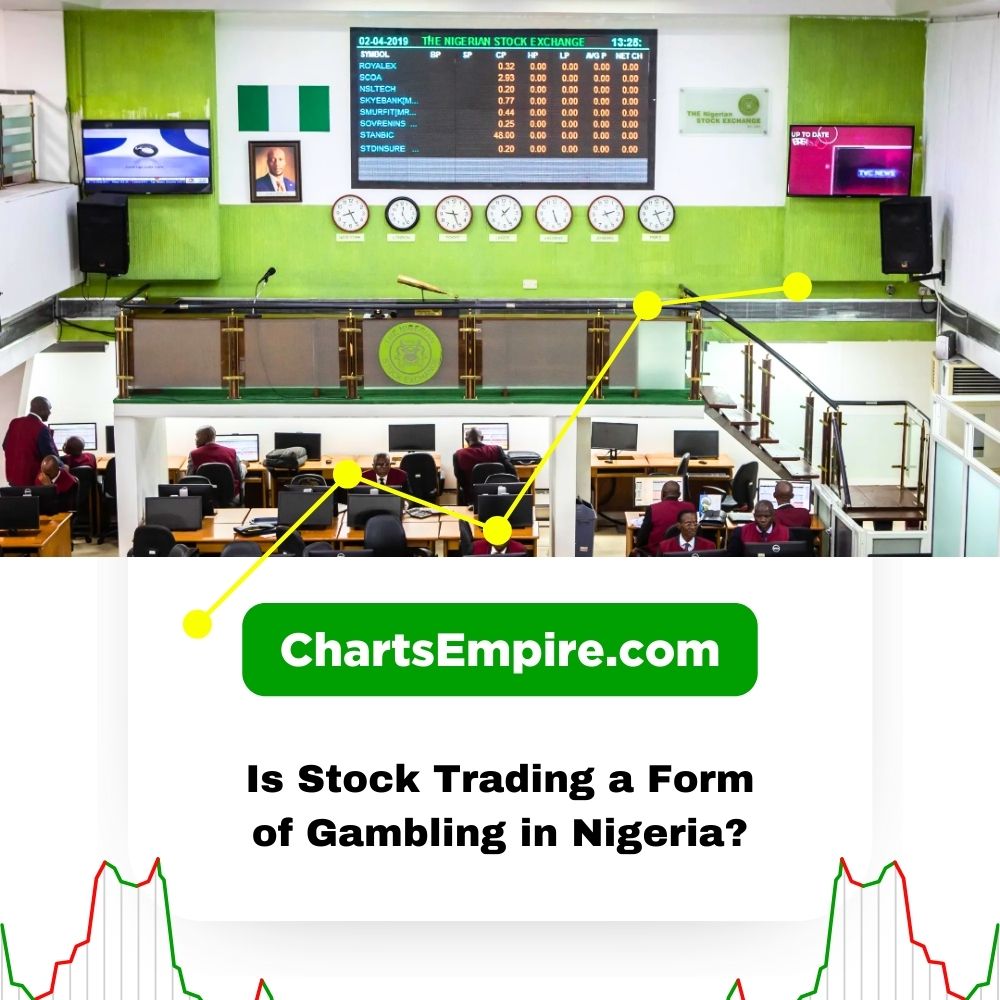
Is stock trading a form of gambling? This is one of the most common questions Nigerians ask when money is involved, prices are moving fast, and stories of big wins and painful losses are everywhere. It is time to finally clarify this in 2026.
In this post, we will break down what gambling really means, what stock trading truly is, why many Nigerians mix the two, when trading crosses the line into gambling, and how professionals separate skill from luck. We will also look at real data, market behavior, and practical examples that apply directly to Nigeria.
By the end of this post, you will clearly understand whether stock trading is gambling or not, why many people lose money while others build wealth, and how to approach the stock market in a way that makes sense.
We included real-world insight and simple explanations that help you decide what side of the line you want to stand on.
What Is Gambling?
Gambling is when you stake money on an outcome you cannot control, hoping to win more money purely by chance. You place a bet, the event happens, and the result is decided mostly by luck, not skill.
Once the bet is placed, you have no further control. Whether it is sports betting, casino games, or lotteries, the outcome is fixed after your money goes in. You cannot manage risk, adjust strategy, or influence the result in any meaningful way.
Gambling is also short-term by nature. You either win or lose within minutes or hours. There is no process, no learning curve that improves odds over time, and no long-term advantage for the player. The system is designed so the house always has the edge.
Most importantly, gambling does not give you ownership of anything. When the game ends, there is no asset, no business, no value left behind. Your money either disappears or doubles, and that is the end of it.
This lack of control, reliance on luck, short time frame, and absence of real value is what defines gambling.
What Is Stock Trading?
Stock trading is the act of buying and selling shares of a company to make profit from price movement. When you buy a stock, you are not guessing numbers. You are buying a small piece of a real business that sells products, employs people, and makes money.
For example, when you buy shares of a bank or telecom company, you become a part-owner of that company. If the business grows and performs well, the value of your shares can increase. That growth is what creates profit.
Stock trading is different from gambling because there is logic behind price movement. Company earnings, management decisions, industry growth, and the overall economy all affect stock prices. These are things you can study and understand.
Very briefly, investing focuses on long-term ownership and growth, while trading focuses on short-term price movement. Both still involve analysis, planning, and risk control.
At its core, stock trading is about owning businesses and managing risk, not betting on luck.
Is Day Trading Gambling in Nigeria
Short answer: No. But for most people, it behaves like gambling.
Day trading is risky because most participants are unprepared, not because the activity itself is luck-based. Data from global and emerging markets shows that 70–90% of retail day traders lose money, mainly due to poor execution, overtrading, and lack of risk control.
In Nigeria, the risk is even higher. Liquidity is thinner, spreads can be wider, and many stocks on the Nigerian Exchange do not support frequent in-and-out trading. Most retail traders also trade without tested strategies or proper data access.
That said, day trading is not gambling by definition. Prices move based on order flow, volume, news, earnings, and market structure. Skilled traders use probability, strict position sizing, predefined exits, and discipline. Casinos don’t allow that. Markets do.
Why Many Nigerians Think Stock Trading Is Gambling – An Expert’s View
After decades in the market, one pattern is clear. Nigerians don’t think stock trading is gambling because of theory, they think so because of experience (often bad experience).
Between 2008 and 2009, the Nigerian Stock Exchange lost over 70% of its value after the banking crisis. Millions of retail investors entered the market at the peak and watched their portfolios collapse. To someone who bought bank stocks in 2007 and saw them crash by 2009, the market did not look like skill. It looked like chance.
Another issue is inflation-adjusted returns. From 2015 to 2020, Nigeria’s inflation averaged over 13%, while many retail investors earned less than that, meaning they lost money in real terms even when stock prices went up.
Also, over 85% of Nigerian retail investors do not rebalance portfolios, use stop-losses, or analyze earnings, according to NGX investor behavior reports. Most buy once and hope. Hope is not a strategy.
So when people trade without risk control, valuation, or time horizon, the outcome naturally feels random. The market wasn’t gambling them. They were gambling the market.
There is also a big misunderstanding about day trading. On social media, trading is often shown as fast money. Screenshots of profits, flashy lifestyles, and promises of “double your money” create the idea that trading is like betting. When people try it without skill and lose, it feels exactly like gambling.
Finally, Nigeria has a strong quick-money culture. Anything that involves money and risk is quickly grouped with betting. But the problem is not stock trading itself. The problem is how many people approach it without learning, planning, or patience.
Key Differences Between Stock Trading and Gambling
Stock trading gives you control. You decide what to buy, when to buy, how much to risk, and when to exit. Gambling offers no such control. Once you place a bet, the outcome is out of your hands.
Stock trading rewards skill, patience, and knowledge. Understanding company earnings, inflation, interest rates, and market cycles matters. Gambling relies mostly on luck.
In trading, risk is managed. Serious traders use position sizing and stop-losses to protect capital. In gambling, you risk money blindly, hoping for a win.
Most importantly, when you buy Nigerian stocks, you gain ownership in real companies, like banks, telecoms and cement firms. These are businesses that generate cash and pay dividends. Gambling gives you nothing to own.
Over time, disciplined stock traders benefit from long-term market growth. Gambling only offers one-off outcomes, usually ending in loss.
Stock Trading vs Gambling Table
| Aspect | Stock Trading | Gambling |
| Control | High control over decisions | No control after betting |
| Skill | Based on analysis and experience | Based mainly on luck |
| Risk | Managed with rules and tools | Blind risk |
| Ownership | Owns shares in real companies | Owns nothing |
| Outcome | Long-term growth possible | One-time win or loss |
When Stock Trading Becomes Gambling
- Trading without proper knowledge of the stock market and how prices move.
- Entering trades without a clear strategy or defined plan.
- Ignoring risk management and risking too much money on one trade.
- Chasing losses by trying to “recover” money quickly after a bad trade.
- Buying stocks based on tips, rumors, or social media hype instead of facts.
- Using borrowed money or excessive leverage that can wipe out capital fast.
Common Myths About Stock Trading and Gambling: What the Data Actually Shows
Myth 1. You must lose money
This belief ignores long-term data. The Nigerian stock market delivered positive long-term returns, with dividend-paying stocks like banking and telecom firms providing consistent income even during volatile years. Losses mostly come from poor timing and zero risk control, not from the market itself.
Myth 2. Only insiders win
If insiders were the only winners, pension funds managing over ₦18 trillion in Nigeria would not rely heavily on equities for growth. These funds follow public information, not insider tips.
Myth 3. It’s pure luck
Studies show markets respond to earnings, inflation, interest rates, and growth, not chance. Casinos have fixed odds. Stock markets don’t.
Myth 4. Stocks are the same as betting
Betting has a negative expected value by design. Stocks represent ownership in cash-generating businesses. One destroys capital over time while the other can build it.
Role of Risk Management in Stock Trading
Risk management is the single biggest line separating traders from gamblers.
In professional stock trading, losses are planned before profits. A stop-loss simply defines how much you are willing to lose on a trade before entering it. This is why seasoned traders survive bad markets. Gamblers don’t set exit points; they stay and hope.
Position sizing controls how much capital goes into one trade. Data shows that traders who risk more than 2–5% of their capital per trade dramatically increase their chances of blowing up their accounts. Most Nigerian retail traders ignore this rule and over-commit capital.
Capital protection matters because markets are uncertain. Even the best traders are wrong 40–60% of the time. What keeps them profitable is that losses are small while wins are larger.
Gamblers don’t manage risk because gambling systems are built with a negative expected value. Risk control cannot change the odds. In stock trading, risk management creates the edge. That is why professionals last decades while gamblers eventually disappear.
Trading vs Gambling: Which Is Better for Nigerians?
From a Nigerian perspective, trading is objectively better than gambling, and the data supports this.
Gambling platforms in Nigeria operate on a negative expected return. The house always wins. This is why Nigeria’s sports betting market keeps growing into hundreds of billions of naira yearly, while most bettors remain financially stagnant.
Stock trading, on the other hand, is tied to real economic growth. Nigeria’s pension funds, managing over ₦18 trillion, invest heavily in equities because stocks build long-term value, not because of luck.
Historically, the Nigerian stock market has rewarded patient capital, especially through dividends from banks, telecoms, and industrial companies listed on the Nigerian Exchange. Gambling has no such compounding effect.
The key difference is control. Trading allows risk management, learning, and improvement over time. Gambling does not.
So in Nigeria, the real comparison is simple:
- Gambling drains money.
- Trading, when done with discipline, builds wealth.
The better option isn’t about excitement. It’s about outcomes.
Questions on Gambling and Stock Investing
1. Why do 90% of day traders fail?
Most day traders fail due to overtrading, poor risk control, high fees, and emotional decisions, not because markets are random. Studies show consistent profitability requires discipline and cost control, which most retail traders lack.
2. Is stock market gambling according to the Bible?
The Bible condemns greed and reckless gain, not ownership or investment. Scriptures like Proverbs 13:11 and Matthew 25:14 – 30 support productive stewardship, planning, and growth of resources, not blind betting.
3. Is it sinful to invest in stocks?
No. Investing is widely viewed by Christian scholars as stewardship, provided it avoids fraud, exploitation, and greed. Ethical investing aligns with biblical principles of wisdom and diligence.
4. Is crypto trading gambling?
It can be, depending on behavior. Crypto markets are highly volatile, but they are still driven by supply, demand, adoption, and technology, not pure chance. Speculation without understanding turns it into gambling.
5. Is forex trading gambling?
No by structure, yes by misuse. Forex is the largest financial market globally and is used by banks and institutions for hedging. It becomes gambling when traders use high leverage without risk control.
The Bottom Line
Is stock trading a form of gambling? This question is best answered by looking at who consistently benefits from the system. In Nigeria, pension funds managing over ₦18 trillion allocate a meaningful share to equities, not because they enjoy risk, but because long-term data shows stocks preserve and grow value better than cash during inflationary periods.
Here is the deeper insight many miss. The stock market is one of the few places where inflation works for disciplined participants and against emotional ones. Between 2010 and 2023, Nigeria experienced double-digit inflation in most years, yet companies that could raise prices (banks, telecoms, cement firms) continued paying dividends and compounding earnings on the Nigerian Exchange. Gambling systems cannot adjust to inflation. Businesses can.
Another angle rarely discussed is behavioral cost. Studies show most retail losses come not from bad assets, but from panic selling, overtrading, and poor timing. These are human errors, not market flaws.
So the real issue is not whether markets resemble betting, but whether participants behave like owners or gamblers. Stock trading is a form of gambling only when it is treated that way.

Omoare-Allen

Welcome to chartsempire.com! I'm Omoare Allen, your guide in the world of finance and beyond. As an accomplished financial markets author, analyst, speculator, investor and mentor, I bring a wealth of expertise to the table. From dissecting market trends to strategic investment, my insights aim to navigate the complexities of the financial landscape. Off the charts, you'll find me on the golf course perfecting my swing, cycling through scenic routes, and diving into captivating reads. I won't make decisions for you, but would rather teach you what works for me, and how you can properly implement trade management skills to help you become confident in your financial goals. Whether you're here to say hi or share vital information, my email box is open for connection. Feel free to reach out through the contact page. See you in the next one☺️ Submit enquiries for writing and guest posting on the 👉 contact us page.